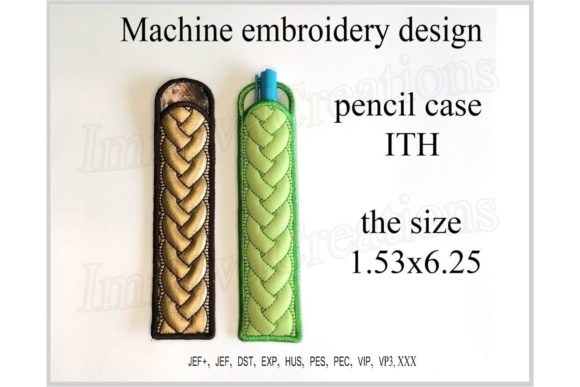
Pencil Case in the Hoop
A Friendly, Handmade Vibe with Real Business Versatility
As an embroidery designer who’s developed hundreds of commercial designs for small businesses—from neighborhood bakeries to indie florists—I immediately recognize Pencil Case in the Hoop as a design that leans into warmth and approachability. The title alone signals a gentle, craft-forward energy: not overly bold or corporate, but intentionally cheerful and tactile. It reads as handmade, playful, and quietly confident—ideal for brands that want to feel personal without sacrificing polish. That tone translates well across merchandise where authenticity matters: aprons for a café, tote bags for a botanical studio, or embroidered patches for a children’s boutique.
Where Pencil Case in the Hoop Shines in Small Business Merch
This machine embroidery design isn’t just for pencil cases—it’s a flexible visual asset. In practice, I’ve seen similar designs succeed as:
- Embroidered patches sewn onto denim jackets or canvas totes—its balanced proportions hold up beautifully at 2.5"–3.5" width;
- Apron embroidery on left chest or pocket—its friendly scale avoids overwhelming workwear while reinforcing brand charm;
- Cap embroidery on front panels, especially for summer pop-ups or school-themed events (fitting its Back To School category);
- Tote bag design centered above the handle seam—clean lines ensure legibility even when fabric stretches;
- Staff uniform accents, like sleeve tabs or collar corners, where subtle branding builds cohesion without clutter;
- Product packaging accents, stitched onto fabric tags or reusable pouches sold alongside handmade goods;
- Customer gifts—think mini embroidered pencil cases given with purchase at a stationery shop or creative studio.
Because it’s labeled “Embroidered in the Hoop,” it likely features clean registration, minimal jump stitches, and thoughtful nesting—key for efficient commercial embroidery runs and consistent results across batches.
Use With Care: Design Limits for Professional Execution
Like any digital embroidery file, Pencil Case in the Hoop has sweet spots—and boundaries. Avoid pushing it into contexts where clarity or durability is compromised:
- Small patch sizes under 1.75": Fine details may blur; always test stitch-out before bulk production;
- Cap fronts with deep curvature: Verify how the design flows over the crown—some hoop-based layouts struggle with tight radiuses;
- Textured fabrics like heavy linen or bouclé: High stitch density can sink or distort—pair with cutaway stabilizer and reduce top tension;
- Dark uniforms or black caps: Confirm thread color contrast—light pastels may fade visually; opt for matte cotton or rayon threads with strong opacity;
- Frequently washed items (e.g., staff aprons): Reinforce with wash-away topping if outlines are delicate, and avoid ultra-thin satin-stitch fills.
How Pencil Case in the Hoop Strengthens Brand Identity
For small business owners, every embroidered detail shapes perception. This design supports trust and recognition by signaling care—not just in product, but in presentation. Its handmade aesthetic aligns naturally with Etsy sellers, craft studios, and local shops where customers value intentionality. When used consistently—as a patch on staff aprons *and* a subtle mark on tote bags—it builds visual consistency without feeling repetitive. It also elevates perceived product value: a custom-embroidered pencil case feels more special than a plain one, and that sentiment transfers to your brand. Plus, because it’s rooted in utility (school supplies), it invites engagement—parents notice it, teachers appreciate it, kids love it. That emotional resonance boosts buyer engagement far beyond decorative appeal.
Practical Embroidery Designer Notes Before You Stitch
Before committing to production, run these checks:
- Test in black and white first: Assess contrast, balance, and negative space without color distraction;
- Verify small-patch viability: Resize to your target patch dimensions and inspect stitch integrity—especially inner curves and letter spacing;
- Review thread color pairings: Match to your brand palette, then test on fabric swatches under natural and retail lighting;
- Inspect spacing and density: Ensure no elements crowd each other—tight stitching can cause puckering on lightweight fabrics;
- Confirm hoop size compatibility: Since it’s “in the hoop,” check if your standard hoops (e.g., 4x4", 5x7") support all sizes offered;
- Test on real substrate: Run a sample on your actual apron twill or cap twill—not just stabilizer;
- Use appropriate stabilizer: Cutaway for knits, tear-away for stable wovens, and topping for napped fabrics;
- Create a printable mockup for client approval—showing how Pencil Case in the Hoop sits on a tote, cap, or uniform helps align expectations;
- Compare beside existing design assets: Does it harmonize with your logo, typography, and other embroidered elements?
- Confirm commercial licensing: Since this is intended for small business merch, ensure the digital embroidery file includes rights for resale, promotional use, and branded apparel.
Remember: “Will come in multiple sizes” means flexibility—but also responsibility. Choose the version that serves your end use, not just the prettiest preview image.
Final Thought: More Than a Pencil Case—A Branding Tool
Pencil Case in the Hoop is more than a cute embroidery file—it’s a ready-made piece of brand language. For a pet brand, it could become a “paw-cil case” patch. For a florist, swap thread colors to match seasonal blooms. For a creative studio, layer it with hand-lettered text in your signature font. Its strength lies in adaptability, clarity, and quiet professionalism. Used thoughtfully, it doesn’t just decorate merchandise—it connects, reassures, and invites return visits. That’s the power of smart, business-first embroidery design.