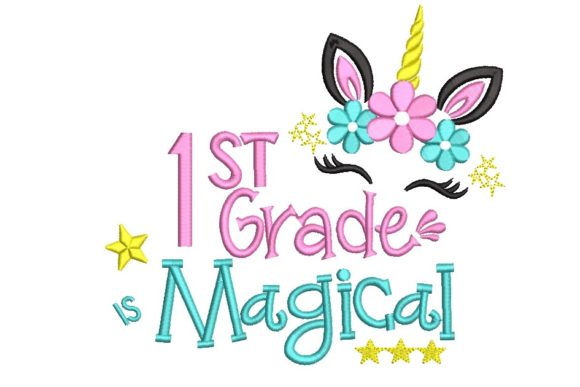
Unicorn 1st Grade Magical
A Designer’s First Look: Charm Without Clutter
When I opened Unicorn 1st Grade Magical, what struck me wasn’t just the whimsy—it was the restraint. So many “cute” school-themed embroidery files drown in glitter, excessive swirls, or overworked lettering. This one doesn’t. The unicorn sits centered, gently arched, with soft curves and clean outlines—no jagged edges, no frantic detail overload. The “1st Grade” text is legible at small scales but avoids thin fonts or fragile serifs. It feels like a design made *for stitching*, not just for screen viewing. That matters—especially when you’re prepping a batch of personalized tote bags for a local elementary school fundraiser.
Where It Shines: Real Projects, Real Fabric
I tested Unicorn 1st Grade Magical on three real-world items: a lightweight cotton canvas tote, a midweight French terry sweatshirt, and a baby rib-knit onesie. On the tote, it stitched cleanly with standard tear-away stabilizer—no puckering, no thread breaks. The satin stitch horn held its shape, and the fill-stitch mane had enough texture to read as “magical,” not muddy. On the sweatshirt, I added light cut-away stabilizer underneath and saw zero distortion around the curves. Most importantly? The design scaled down gracefully to a 3.5-inch width without losing definition—ideal for sleeve placement or cap fronts.
As a designer who regularly sources embroidery files for boutique baby lines, I appreciated how well it translated to delicate garments. The stitch density feels intentional—not sparse enough to look cheap, not dense enough to stiffen a onesie. It’s a rare balance for a Back To School design that doubles as nursery decor or a first-day-of-school keepsake.
Where to Pause—and Plan Ahead
- Thin or stretchy fabrics: Avoid using Unicorn 1st Grade Magical on lightweight jersey or modal blends without proper stabilization. The curved horn and tail rely on consistent fabric tension—stretch can distort those smooth lines.
- Dark backgrounds: Test thread colors carefully. The original file likely assumes light fabric, so if you’re stitching on navy or charcoal, swap to high-contrast threads (e.g., bright pink or metallic silver) and verify fill stitch coverage in your embroidery software preview.
- Tiny hoops & curved surfaces: While it adapts well to caps, avoid placing it too close to the bill seam or crown curve unless you’ve confirmed the hoop size fits comfortably. Some versions of this design may push the outer limits of a 4x4 hoop—always check before hooping.
- Frequent-wash items: For tea towels, aprons, or kids’ everyday tees, reinforce with a light iron-on backing post-stitching. The design’s charm lies in its softness—don’t let repeated laundering dull its clarity.
What It Does for Your Brand—and Your Buyers
As an Etsy seller and small shop owner, I pay attention to how a design affects perceived value. Unicorn 1st Grade Magical reads as thoughtful, not generic. Customers notice that. When you pair it with quality fabric and clean finishing—say, on a linen pillow cover or an organic cotton backpack—it elevates the whole handmade product. Parents buying personalized gifts aren’t just purchasing embroidery; they’re buying recognition, warmth, and a little pride in that milestone. This design delivers that quietly—no shouting, no clichés.
It also supports brand consistency. Whether you’re building a line of Back To School embroidery bundles or curating seasonal digital embroidery files, Unicorn 1st Grade Magical fits seamlessly alongside other joyful-but-refined themes (think “First Day Butterflies” or “Reading Rockstar”). Its visual personality is cohesive, not chaotic—making it easier to create printable mockups or cohesive social media galleries.
Practical Notes Every Embroiderer Should Run Through
- Always stitch a test on scrap fabric—same type, same stabilizer, same thread. Watch how the horn tip and “1st” letters land. If they feather or blur, adjust tension or switch to a finer needle.
- Review stitch density in your software. Overly dense fills trap moisture and stiffen fabric—especially problematic on baby wear or summer tees.
- Check licensing before selling finished items. Since the description says “This machine embroidery design comes with mult…” (truncated), verify whether commercial use is included—or if you need an extended license for your craft business.
- Compare black-and-white mockups on both light and dark backgrounds. Does the silhouette hold up? Does the text remain legible at 3 inches wide?
- Use proper stabilizer for the end use: Tear-away for stable woven fabrics, cut-away for knits, and wash-away for delicate layers like lace overlays or applique design prep.
- Confirm hoop size compatibility before listing it as part of a digital embroidery file bundle—your buyers will thank you.
Final Thought: Not Just Cute—Consistently Crafted
Unicorn 1st Grade Magical isn’t flashy—but it’s reliable. As a working designer, I reach for it when I need embroidery that looks hand-chosen, not auto-generated. It works for custom apparel, embroidered patches, holiday embroidery (yes—even for “first Christmas as a 1st grader”), and small shop merchandise where authenticity matters more than volume. It doesn’t try to do everything. It does one thing beautifully: celebrate a meaningful moment with quiet confidence, stitch by thoughtful stitch.