Boy with Crayon Colors Quick Stitch
A Designer’s First Look: Playful, Not Precious
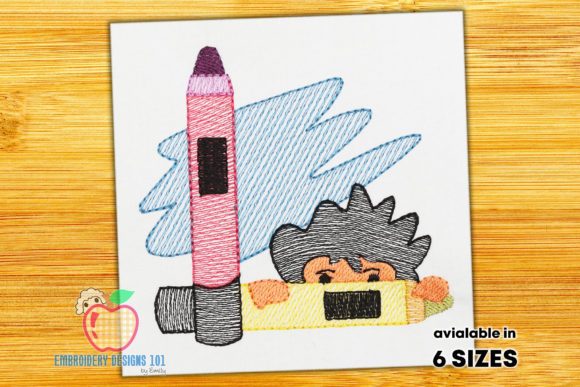
When I opened Boy with Crayon Colors Quick Stitch, my first thought wasn’t “cute”—it was “usable.” There’s a lightness to the composition: a child mid-draw, crayons radiating like sunbeams, clean outlines, and intentional negative space. It doesn’t try to mimic realism—it leans into stylized charm. That’s smart. In real-world embroidery, especially for Back To School projects, you need designs that read clearly at 3–4 inches tall on a tote bag or chest pocket—not ones that blur into mush when stitched.
Where It Shines (and Where It Doesn’t)
I tested Boy with Crayon Colors Quick Stitch on three real project types: a cotton twill apron for a local art teacher’s boutique, a lightweight baby onesie, and a medium-weight canvas tote for a craft fair stall. On the apron? Excellent. The design’s open layout let the fabric breathe—no dense fill stitches bogging it down. The crayons popped in bright thread against natural twill, and the boy’s face stayed legible without over-stitching.
On the onesie? Caution needed. Because this isn’t a 100% filled design, fine details—like the tip of the crayon he’s holding—rely heavily on stitch placement and stabilizer support. With lightweight knit and minimal stabilizer, those thin satin-stitched lines softened slightly. Not ruined—but not crisp enough for a high-end baby gift listing. For Etsy sellers offering personalized baby embroidery, I’d recommend pairing it with tear-away + cutaway combo stabilizer and testing thread tension first.
The tote bag was its sweet spot. At 4.25″ wide, the design balanced presence and proportion. Customers paused at the booth—not just because of color, but because the shape felt intentional, friendly, and age-appropriate. No one mistook it for clipart. That matters. When you’re selling handmade product, perceived craftsmanship starts with how cleanly a machine embroidery design translates to fabric.
Fabric & Fit: Know Before You Hoop
- Thin or stretchy fabrics: Avoid tight satin-stitch edges without proper stabilization—those crayon tips can pucker or distort.
- Dark fabrics: This design relies on contrast. Test your thread colors against black or navy before stitching. A pale yellow crayon won’t read on charcoal without careful thread selection.
- Caps and curved surfaces: The upward arc of the crayons works well on front panels, but avoid placing the full design across a crown seam—the distortion pulls the boy’s posture off-balance.
- Textured weaves (like burlap or heavy linen): The open structure helps here—less fill means fewer skipped stitches and cleaner registration.
What It Adds to Your Product—and What It Asks of You
Boy with Crayon Colors Quick Stitch elevates a simple item into something emotionally resonant. A plain sweatshirt becomes a “first day of art class” keepsake. A tea towel turns into a teacher appreciation gift with quiet personality. That’s value—not just visual, but narrative.
But it also asks for intentionality. Because it’s not overly dense, customers will notice stitching quality more—not less. If your satin stitch wobbles on the crayon edges, or your thread tension leaves tiny loops near the boy’s hand, it breaks the illusion of polish. For small shop owners and Etsy sellers, that directly impacts buyer trust and repeat orders.
It also invites thoughtful branding. This isn’t a standalone logo—it’s a story prompt. Pair it with handwritten-style font in your printable mockup, or use it as a central motif on a set of nursery pillows. Its simplicity makes it adaptable, but only if you treat it as a design asset—not just a drop-in graphic.
Practical Notes Every Embroidery Designer Should Check
- Always run a test stitch on scrap fabric matching your final project’s weight and weave.
- Review stitch density in your embroidery software—even “quick stitch” files vary. Look for tight clusters where crayons meet the hand; those areas may need slight digitizing tweaks for your machine.
- Confirm hoop size compatibility. Multiple sizes are offered, but don’t assume the 3″ version fits your smallest hoop without checking actual dimensions.
- Inspect small details at 200% zoom in your editing software—especially the boy’s eyes and crayon tips. Are they defined by running stitch or satin? That affects clarity on textured fabric.
- Test the design in grayscale mockups. Does the shape hold up on dark backgrounds? Does the negative space still read as intentional—or just empty?
- Verify licensing terms before using in commercial embroidery or digital embroidery file bundles. Some “Quick Stitch” collections allow finished product sales but restrict resale of the file itself.
Final Thought: A Reliable Back To School Workhorse
Boy with Crayon Colors Quick Stitch won’t win awards for technical complexity—but it doesn’t need to. It solves a real problem: finding an embroidery file that feels joyful, scales well, stitches consistently, and supports the story your customer wants to tell. Whether you’re embroidering custom apparel for a school fundraiser, building a line of handmade nursery decor, or prepping holiday embroidery kits for your craft business, this design earns its place in your active folder—not the archive.
Just remember: its ease is earned, not given. Respect the fabric. Respect the thread. And always, always test first. That’s how “quick stitch” becomes trusted stitch.