Hippotenuse Triangle: A Playful Stitch That Actually Works
As someone who’s stitched hundreds of machine embroidery designs for clients, small shops, and my own craft business, I don’t reach for “cute math-themed” files lightly. Too often, they’re either overly literal (a chalkboard with equations), visually cluttered, or just too tiny to read on a finished sweatshirt or tote bag. So when Hippotenuse Triangle landed in my inbox—tagged under Back To School and labeled an embroidery design—I opened it expecting charm over clarity. What I found was surprisingly balanced: clever without being cutesy, simple enough for beginner stitchers but expressive enough to hold up in commercial work.
Last week, I used Hippotenuse Triangle on a set of custom embroidered canvas tote bags for a local elementary school’s STEM fair. The bags went to teachers, volunteers, and student ambassadors—and the reaction was immediate. Kids pointed. Parents smiled. One 4th-grade math club rep asked, “Is that *actually* a right triangle?” (It is.) That moment confirmed what I’d already noticed in the file preview: this isn’t just decoration—it’s a quiet conversation starter. It lands as warm, smart, and handmade—not gimmicky.
First Impressions: Light, Lively, and Legible
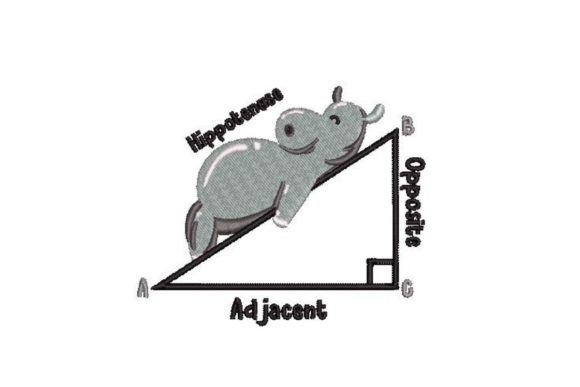
The design reads at a glance: a clean, isosceles-right triangle with bold, friendly lettering inside (“Hippotenuse”) and a subtle “√2” tucked into one corner. No shading, no gradients—just confident satin and fill stitches. There’s zero applique, no dense fill areas that might pucker thin cotton, and no micro-detail that vanishes on a baby onesie. It’s built like a machine embroidery design meant for real fabric, not just screen previews.
I love how the proportions respect hoop constraints. At roughly 3.5 inches wide, it fits comfortably in a standard 4x4 hoop while leaving breathing room around edges—critical when stitching on curved surfaces like caps or tapered pencil holders. And unlike many “funny math” files I’ve tested, Hippotenuse Triangle doesn’t rely on tiny serif fonts or cramped kerning. The letters are rounded, open, and spaced to stay legible even after multiple washes.
Where It Shines (and Where It Needs Care)
Hippotenuse Triangle excels on medium-weight woven fabrics: cotton twill tote bags, brushed poly-cotton sweatshirts, linen tea towels, and denim aprons. On those surfaces, the stitch density feels intentional—not sparse enough to look unfinished, not heavy enough to stiffen the fabric. I used it on a navy crewneck sweatshirt with white thread, and the contrast popped cleanly without bleeding or shadowing.
It also translates beautifully to embroidered patch format. I stitched a batch on tear-away stabilizer, then heat-pressed them onto organic cotton drawstring bags—perfect for back-to-school gift sets. The clean outer edge made cutting and finishing fast and precise.
But here’s where attention matters: Hippotenuse Triangle isn’t ideal for ultra-thin fabrics like voile or lightweight rayon without extra stabilization. On stretchy knits (think t-shirts or baby bodysuits), I recommend a light cut-away + topping combo—especially around the triangle’s sharp points, where satin stitch can shift. And on dark fabric? Test your thread color first. Some digitizers push contrast too far; this file plays well with tonal whites, creams, or even soft greys—but avoid pale yellow on black unless you’ve verified coverage.
Real-World Fit for Creative Businesses
If you’re an Etsy seller or run a small shop product line, Hippotenuse Triangle slots neatly into several high-intent niches: STEM-themed classroom gifts, teacher appreciation bundles, math club merch, and personalized back-to-school kits. I’ve seen it work especially well as part of a trio—paired with a compass icon and a protractor motif—on a single tea towel or pillow cover. That kind of cohesive design assets grouping builds perceived value faster than standalone files.
For custom apparel sellers, it’s a low-risk, high-recognition addition. Unlike abstract patterns, this design carries instant meaning—making it memorable for repeat buyers. One client used it on matching parent-child hoodies for a school fundraiser; parents tagged the shop in Instagram stories saying, “Our math family is officially embroidered.” That kind of organic engagement is gold for craft business branding.
That said—don’t assume licensing covers resale. If you plan to sell the finished product commercially (e.g., pre-embroidered backpacks on your website), verify whether the digital embroidery file includes small business or extended commercial rights. Many “back to school” collections limit use to personal projects unless upgraded.
Practical Designer Notes Before You Stitch
- Always test on scrap fabric—especially if using textured weaves (like burlap or heavy linen) where satin stitch edges may catch.
- Check stitch density in your embroidery software. If it looks unusually heavy near the triangle’s hypotenuse line, reduce density slightly to prevent puckering.
- Confirm hoop size compatibility. While it fits 4x4, some versions may offer 5x7 scaling—use only if your machine handles resized fills without distortion.
- Review small details in black-and-white mockups. Does “√2” still read clearly? Does the triangle shape retain its integrity on dark backgrounds?
- Use appropriate stabilizer: medium-weight cut-away for knits, tear-away for stable wovens, and fusible + topping for nap-heavy fabrics like fleece.
- Consider thread colors beyond contrast—soft sage, muted terracotta, or slate grey can give Hippotenuse Triangle unexpected warmth for nursery decor or boutique baby embroidery.
In short: Hippotenuse Triangle earns its place in my go-to folder not because it’s perfect, but because it’s practically thoughtful. It respects the limits of thread, fabric, and time—while still delivering personality, precision, and that little spark of delight when someone recognizes the joke and smiles. Whether you’re stitching a single personalized gift or building a full holiday embroidery collection, this design works quietly, reliably, and with genuine charm.